데일리스터디
Martin Luther King 본문
Martin Luther King Jr. was a very important American leader who lived in a time when some people were treated unfairly because of the color of their skin. He had a big dream: he wanted everyone to be treated equally and with respect, no matter what they looked like.
One of his main ideas was about "nonviolent resistance." This means trying to make big changes and fight for what is right without using violence or fighting back with anger. He believed that love and understanding were stronger than hate and violence. He organized peaceful protests, like marches and sit-ins, to show that people wanted change. It's like when you want a toy and you ask nicely instead of yelling and grabbing.
Martin Luther King Jr. also believed in justice and fairness for everyone. He thought that all people should have the same rights and opportunities, like going to the same schools, using the same buses, and having the chance to get good jobs. He talked a lot about equality and how important it is for everyone to be treated with dignity.
He was a great speaker and his words inspired many people. He talked about his dream of a world where people would be judged by their character, not by the color of their skin. This dream is still very important today.
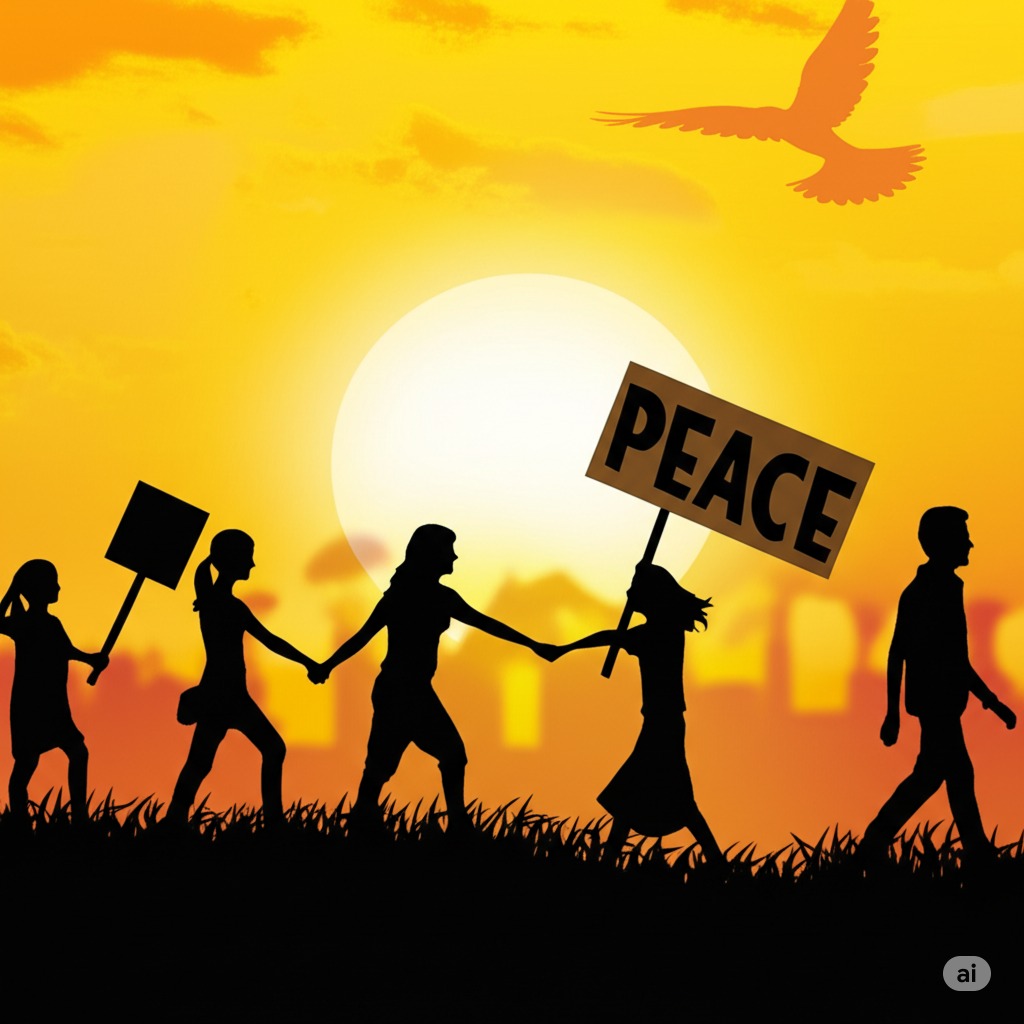
Now, let's create an image that shows Martin Luther King Jr.'s philosophy. Imagine a group of people with different skin colors walking together hand-in-hand towards a bright sunrise. They are smiling and look peaceful. Above them, there is a dove flying, which is a symbol of peace. In the background, you can see the shadows of people protesting peacefully with signs that say "Equality" and "Peace." The image represents the idea of people coming together in unity and peace to achieve equality, inspired by Martin Luther King Jr.'s dream.
Talking About Martin Luther King
Study Guide: Understanding Martin Luther King Jr.'s Philosophy
Quiz
- What was Martin Luther King Jr.'s main dream for society?
- Explain the core concept of "nonviolent resistance" as practiced by Martin Luther King Jr.
- What specific actions did Martin Luther King Jr. organize to demonstrate the desire for change?
- Beyond equal treatment, what other fundamental concept did Martin Luther King Jr. advocate for everyone?
- What examples of unequal opportunities did Martin Luther King Jr. likely oppose?
- What quality of Martin Luther King Jr. is highlighted as being particularly impactful in inspiring others?
- According to the text, by what characteristic did Martin Luther King Jr. believe people should be judged?
- What symbol is suggested to represent peace in an image depicting Martin Luther King Jr.'s philosophy?
- What kinds of words might appear on signs held by peaceful protesters in an image illustrating King's ideas?
- The suggested image for King's philosophy shows people walking together towards a specific natural phenomenon. What is it?
Quiz Answer Key
- His main dream was for everyone to be treated equally and with respect, regardless of the color of their skin.
- Nonviolent resistance means trying to achieve significant societal changes and fight for what is right without resorting to violence or retaliating with anger.
- He organized peaceful protests such as marches and sit-ins to show that people desired change.
- He also believed strongly in justice and fairness for everyone, including having the same rights and opportunities.
- He likely opposed unequal opportunities like separate schools, segregated bus systems, and barriers to getting good jobs.
- He is highlighted as a great speaker whose words were very inspiring to many people.
- He believed people should be judged by their character, not by the color of their skin.
- A dove is suggested as a symbol of peace in an image representing his philosophy.
- Signs in such an image might say words like "Equality" and "Peace."
- The image shows people walking together towards a bright sunrise.
Essay Questions
- Analyze the connection between Martin Luther King Jr.'s belief in the power of love and understanding and his commitment to nonviolent resistance.
- Discuss the enduring relevance of Martin Luther King Jr.'s dream of a world where people are judged by their character in contemporary society.
- Compare and contrast the concept of nonviolent resistance with other methods of achieving social or political change.
- Explain how the suggested image illustrating Martin Luther King Jr.'s philosophy effectively captures his core ideas and aspirations.
- Evaluate the significance of specific historical events or movements influenced by Martin Luther King Jr.'s leadership and philosophy.
Glossary of Key Terms
- Nonviolent Resistance: A method of bringing about social or political change without using violence, relying instead on peaceful protests, civil disobedience, and other nonviolent tactics.
- Equality: The state of being equal, especially in status, rights, and opportunities.
- Justice: The quality of being fair and reasonable; the administration of the law or authority in maintaining this.
- Fairness: Impartial and just treatment or behavior without favoritism or discrimination.
- Dignity: The state or quality of being worthy of honor or respect.
- Protest: A statement or action expressing disapproval of or objection to something.
- Marches: Organized walks taken by a large group of people to protest or celebrate something.
- Sit-ins: A form of protest in which demonstrators occupy a place and refuse to leave until their demands are met.
- Character: The mental and moral qualities distinctive to an individual.
- Symbol: A thing that represents or stands for something else, especially a material object representing something abstract.
( N.B. 위 콘텐츠는 Google AI Studio 로 제작한 것입니다 )


