데일리스터디
Toegye 본문
Toegye was a very respected and wise scholar in Korean history. His main idea is about something called "Yi" and "Gi," just like Yulgok, but with a little bit of a different focus. Think of "Yi" as the good and perfect reason for everything, like the North Star that always points in the right direction. "Gi" is like the energy or the stuff that makes things happen in the real world, but it can sometimes be mixed with good and bad.
Toegye emphasized that "Yi" is the most important thing to focus on. He believed that by understanding and following "Yi," we can become better people and make a better society. It's like always trying to steer your boat towards the North Star to stay on the right path.
He also believed in the power of the mind and the importance of self-reflection. Toegye thought we should constantly look inside ourselves to understand our own thoughts and actions and try to make them more in line with "Yi." It's like having a mirror to check if you're doing the right thing.
Toegye was a great teacher and he deeply valued learning. He spent many years studying and teaching others, wanting to share his understanding of "Yi" and how it could help people live good and meaningful lives. He believed that through learning and self-discipline, everyone could improve themselves.
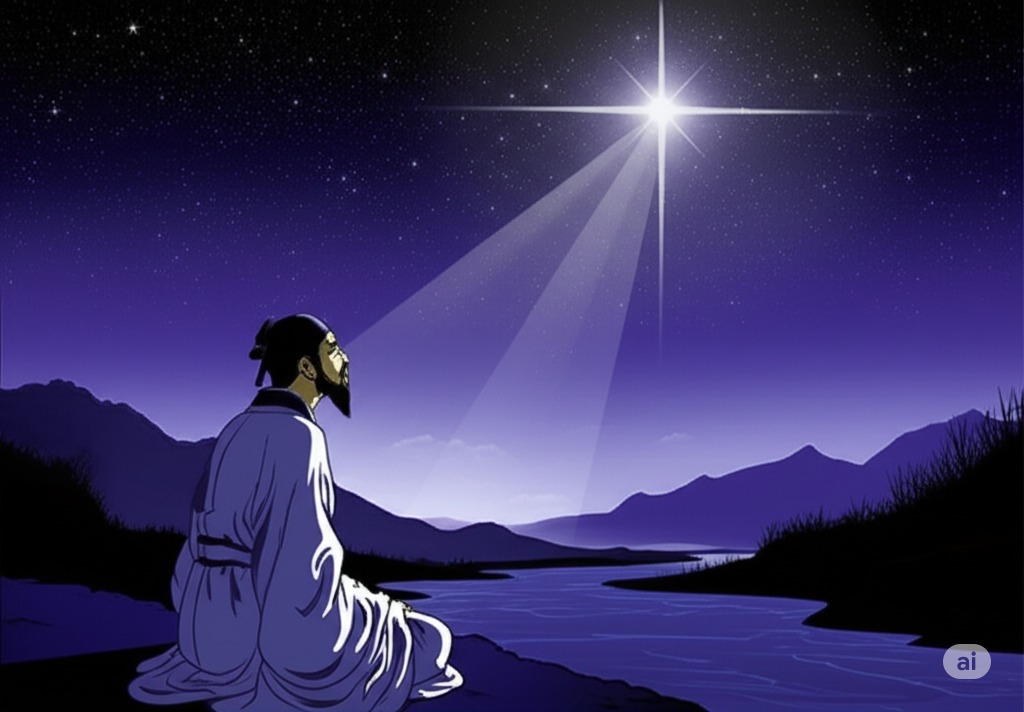
Now, let's create an image that shows Toegye's philosophy. Imagine a bright star shining high in the night sky, representing "Yi," the guiding principle of goodness. Below, a calm and thoughtful scholar (representing Toegye) is sitting in a quiet study, looking up at the star while reading a book about wisdom. A clear stream is flowing nearby, symbolizing the pure and constant nature of "Yi." The scholar's posture and the peaceful surroundings show the importance of reflection and learning to understand and follow the guiding light of "Yi." The scene has a serene and inspiring atmosphere, emphasizing the pursuit of moral perfection.
Study Guide: Toegye's Philosophy
Key Concepts and Themes
- Toegye's central philosophical framework revolves around the concepts of "Yi" and "Gi."
- He shared this framework with Yulgok, but with a distinct emphasis.
- "Yi" is presented as the fundamental principle, the perfect and good reason for existence. It is described with analogies like the North Star, representing a constant and ideal guide.
- "Gi" is the material force or energy that manifests in the real world. Unlike "Yi," "Gi" can be a mix of good and bad.
- Toegye strongly prioritized "Yi," viewing it as the most crucial element to understand and follow.
- He believed that aligning oneself with "Yi" is the path to personal betterment and societal improvement. The analogy of steering a boat towards the North Star illustrates this idea.
- The power of the mind and the practice of self-reflection are integral to Toegye's philosophy.
- He advocated for continuous introspection to understand one's inner state (thoughts and actions) and to bring them into harmony with "Yi." This is compared to using a mirror for self-assessment.
- Toegye was a devoted teacher who highly valued learning.
- He dedicated significant time to studying and instructing others, aiming to disseminate his insights on "Yi" and its practical application for leading virtuous and meaningful lives.
- He held the conviction that personal growth and improvement are attainable through consistent learning and self-discipline.
- The provided image description visually encapsulates Toegye's philosophy, depicting "Yi" as a guiding star, Toegye as a contemplative scholar engaged in learning, and a stream representing the purity of "Yi." The scene emphasizes reflection, learning, and the pursuit of moral perfection.
Short Answer Quiz
- What are the two main concepts that form the basis of Toegye's philosophy?
- How does Toegye differentiate "Yi" from "Gi"? Use the analogy provided in the text.
- Which of the two concepts, "Yi" or "Gi," did Toegye emphasize as more important?
- According to Toegye, how does understanding and following "Yi" benefit individuals and society?
- What role did self-reflection play in Toegye's philosophy?
- What analogy is used to describe the practice of self-reflection according to Toegye?
- How did Toegye view the importance of learning?
- What did Toegye believe was achievable through learning and self-discipline?
- Describe the symbolic representation of "Yi" in the image description provided.
- What does the calm scholar in the image description represent, and what is he doing?
Short Answer Quiz Answer Key
- The two main concepts that form the basis of Toegye's philosophy are "Yi" and "Gi."
- Toegye differentiates "Yi" as the perfect, good reason for everything, like the North Star, while "Gi" is the energy that makes things happen in the real world but can be mixed with good and bad.
- Toegye emphasized "Yi" as the most important thing to focus on.
- According to Toegye, understanding and following "Yi" allows people to become better individuals and contribute to a better society.
- Self-reflection was important in Toegye's philosophy because he believed people should look inside themselves to understand their thoughts and actions.
- The analogy used to describe self-reflection is having a mirror to check if you're doing the right thing.
- Toegye deeply valued learning and spent many years studying and teaching others.
- Toegye believed that everyone could improve themselves through learning and self-discipline.
- In the image description, "Yi" is symbolically represented as a bright star shining high in the night sky, acting as a guiding principle of goodness.
- The calm scholar in the image description represents Toegye himself, and he is sitting in a quiet study looking up at the star while reading a book about wisdom.
Essay Format Questions
- Compare and contrast Toegye's emphasis on "Yi" with the concept of "Gi," discussing the implications of this distinction for human action and societal improvement.
- Analyze the significance of self-reflection and the power of the mind in Toegye's philosophical framework. How do these elements contribute to his vision of moral development?
- Discuss the role of education and teaching in Toegye's philosophy. How did he believe learning could facilitate the understanding and application of "Yi"?
- Evaluate the effectiveness of the analogies (North Star, boat, mirror, stream) used in the text to explain Toegye's concepts. How do they enhance understanding of his ideas?
- Explore the relationship between the individual's pursuit of aligning with "Yi" and the potential for creating a better society, according to Toegye's perspective.
Glossary of Key Terms
- Toegye: A highly respected and wise scholar in Korean history, the subject of the provided text.
- Yi: The fundamental principle in Toegye's philosophy, representing the good and perfect reason for everything. It is considered a guiding principle and ideal.
- Gi: The material force or energy in Toegye's philosophy, representing the stuff that makes things happen in the real world. It can be a mixture of good and bad.
- Yulgok: Another scholar in Korean history who shared a similar philosophical framework involving "Yi" and "Gi," but with a different focus compared to Toegye.
- Self-reflection: The practice of looking inward to examine one's own thoughts, feelings, and actions, a key component of Toegye's philosophy for aligning with "Yi."
- Self-discipline: The ability to control one's own behavior and impulses, which Toegye believed was essential, along with learning, for personal improvement.
( N.B. 위 콘텐츠는 Google AI Studio 로 제작한 것입니다 )


