데일리스터디
Sick / Shel Silverstein 본문
( an excerpt from "Peggy Ann McKay's Malady and Miracle Cure" by Shel Silverstein )
"I cannot go to school today,"
"나는 오늘 학교에 갈 수 없어요,"
"Said little Peggy Ann McKay."
"작은 페기 앤 맥케이가 말했어요."
"I have the measles and the mumps,"
"나는 홍역과 볼거리가 있고,"
"A gash, a rash and purple bumps."
"상처와 발진, 그리고 보라색 돌기가 있어요."
"My mouth is wet, my throat is dry,"
"입은 젖었는데 목은 마르고,"
"I'm going blind in my right eye."
"오른쪽 눈은 멀어 가고 있어요."
"My tonsils are as big as rocks,"
"내 편도는 바위만큼 커졌고,"
"And I've got chickenpox."
"그리고 수두에 걸렸어요."
"My elbow's bent, my spine is weak,"
"팔꿈치는 굽었고, 척추는 약해졌어요."
"I cough real loud when I try to speak."
"말하려고 하면 아주 크게 기침이 나와요."
"I'm nauseous, I have dizzy spells,"
"나는 메스껍고, 어지럼증이 나요."
"And my toes are turning purple bells."
"그리고 내 발가락들은 보라색 종으로 변하고 있어요."
"My bones all ache, my knees are sore,"
"뼈들은 모두 아프고, 무릎은 쑤셔요."
"And my feet are cold and wet the floor."
"그리고 내 발은 차갑고 바닥을 적셔요."
"I have a temperature, my face is pale,"
"열이 나고, 얼굴은 창백해요."
"And I have a hangnail, and my tongue is stale."
"그리고 손톱 거스러미가 있고, 혀는 텁텁해요."
"My burp is loud, my hiccups hurt,"
"내 트림은 크고, 딸꾹질은 아파요."
"And I've got a crick down in my shirt."
"그리고 셔츠 아래로 뻐근함이 느껴져요."
"I have the flu, my head feels light,"
"나는 독감에 걸렸고, 머리가 띵해요."
"I coughed all day and cried all night."
"나는 하루 종일 기침하고 밤새 울었어요."
"I've got a pain in my abdomen,"
"배에 통증이 있고,"
"And a tickle in my thorax when"
"기침, 재채기, 웃음, 또는 쌕쌕거릴 때면"
"I cough or sneeze or laugh or wheeze."
"가슴에 간지러움이 느껴져요."
"My voice is cracking, please, oh please,"
"내 목소리는 갈라져요, 제발, 제발,"
"Don't make me go to school today."
"오늘 학교에 가지 않게 해 주세요."
Then mother said, "Okay, you stay."
그러자 엄마가 말했어요, "그래, 너는 집에 있거라."
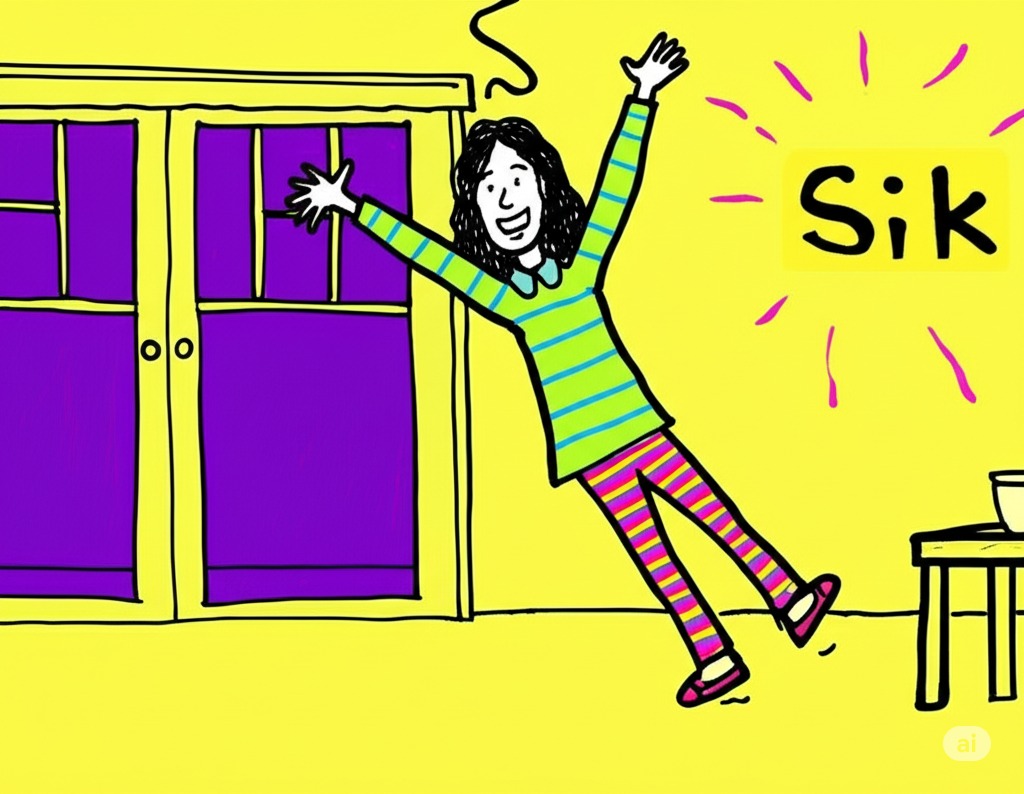
And Peggy Ann McKay jumped up and cried,
그러자 페기 앤 맥케이는 벌떡 일어나 소리쳤어요.
"Why, thank you!" then she smiled and died.
"오, 고맙습니다!" 그러고 나서 그녀는 미소짓고 죽었어요.
Peggy Ann McKay's Malady and Miracle Cure: A Study Guide
I. Quiz: Short Answer Questions
- What is the primary reason Peggy Ann McKay gives for not wanting to go to school? List at least three distinct ailments she claims to have.
- Describe the progression of Peggy Ann's stated symptoms throughout the poem. Do they become more or less severe as she lists them?
- How does Peggy Ann's mother respond to her daughter's extensive list of ailments? What is the immediate effect of this response on Peggy Ann?
- Identify two humorous or exaggerated physical descriptions Peggy Ann uses to describe her symptoms.
- What is the significance of the line "My toes are turning purple bells"? How does this contribute to the poem's overall tone?
- Beyond physical symptoms, what other types of discomfort does Peggy Ann claim to experience? Mention at least two.
- What does Peggy Ann's sudden change in demeanor at the end of the poem suggest about the authenticity of her earlier claims?
- How does the poem use rhyme and rhythm to enhance its humorous and somewhat absurd tone? Provide an example.
- What is the "miracle cure" alluded to in the title of the excerpt, based on the poem's conclusion?
- In your own words, what do you think is the main message or underlying theme of "Sick" by Shel Silverstein?
II. Quiz Answer Key
- Peggy Ann McKay's primary reason for not wanting to go to school is her extensive list of illnesses. She claims to have the measles, mumps, chickenpox, a gash, a rash, purple bumps, a bad throat, eye problems, aching bones, the flu, and many more.
- Peggy Ann's stated symptoms become increasingly numerous and exaggerated as she lists them, moving from common childhood ailments to highly specific and often comical physical complaints. This escalation contributes to the poem's humorous and over-the-top nature.
- Peggy Ann's mother responds by simply saying, "Okay, you stay." The immediate effect of this permission is a dramatic and instantaneous recovery; Peggy Ann jumps up, thanks her mother, smiles, and then "died."
- Two humorous or exaggerated physical descriptions Peggy Ann uses include "My tonsils are as big as rocks" and "My toes are turning purple bells." These hyperboles add to the poem's whimsical and unrealistic portrayal of illness.
- The line "My toes are turning purple bells" is significant because it's a completely absurd and fantastical symptom, highlighting the highly exaggerated and likely feigned nature of Peggy Ann's illness. It contributes to the poem's humorous and whimsical tone, pushing the boundaries of believable ailments.
- Beyond physical symptoms, Peggy Ann claims to experience discomforts such as a "crick down in my shirt" and her "tongue is stale." She also mentions emotional distress like crying all night.
- Peggy Ann's sudden change in demeanor, from being extremely ill to jumping up and smiling the moment she gets her way, strongly suggests that her earlier claims were not authentic. It implies she was feigning illness to avoid school.
- The poem uses a consistent AABB rhyme scheme and a simple, repetitive rhythm, characteristic of children's poetry. This structure enhances its humorous and absurd tone by creating a lighthearted, almost singsong quality, even when describing serious-sounding ailments. For example, "mumps" rhymes with "bumps" and "dry" with "eye."
- The "miracle cure" alluded to in the title, based on the poem's conclusion, is simply getting permission to stay home from school. Once Peggy Ann achieves her goal, her "sickness" instantly disappears, suggesting it was never real.
- The main message or underlying theme of "Sick" is likely about the common childhood desire to avoid school by feigning illness. It playfully highlights the exaggerated complaints children might use and the immediate "recovery" once their wish is granted, portraying the situation with humor and irony.
III. Essay Format Questions
- Analyze how Shel Silverstein uses hyperbole and absurd imagery to create humor and convey the true nature of Peggy Ann McKay's "illness."
- Discuss the role of the mother in the poem. How does her simple response ultimately resolve Peggy Ann's conflict, and what does this resolution imply about the dynamic between them?
- Examine the poem's structure, including its rhyme scheme and rhythm. How do these poetic elements contribute to the overall tone and the reader's understanding of the poem's central theme?
- The title of the excerpt refers to "Peggy Ann McKay's Malady and Miracle Cure." In what ways does the poem fulfill and subvert these expectations, particularly concerning the "malady" and the "miracle cure"?
- What social commentary, if any, might "Sick" by Shel Silverstein be making about childhood, responsibility, or the dynamics within a family?
IV. Glossary of Key Terms
- Malady: A disease, illness, or ailment. In the context of the poem, it refers to Peggy Ann's claimed sicknesses.
- Miracle Cure: A seemingly impossible or extraordinarily effective remedy for an illness. In the poem, it's humorously applied to Peggy Ann's sudden recovery.
- Hyperbole: Exaggerated statements or claims not meant to be taken literally. The poem uses hyperbole extensively to describe Peggy Ann's symptoms (e.g., "tonsils are as big as rocks").
- Absurd Imagery: Visual descriptions that are illogical, ridiculous, or contrary to common sense. Examples include "toes are turning purple bells" and "a crick down in my shirt."
- Tone: The general character or attitude of a piece of writing. The poem's tone is primarily humorous, whimsical, and ironic.
- Rhyme Scheme: The pattern of rhymes at the end of each line of a poem or song. "Sick" uses a consistent AABB rhyme scheme.
- Rhythm: A strong, regular, repeated pattern of movement or sound. The poem has a simple, sing-song rhythm that makes it memorable and lighthearted.
- Irony: The expression of one's meaning by using language that normally signifies the opposite, typically for humorous or emphatic effect. The sudden "death" after getting her way is an example of ironic humor.
- Feigned: Pretended; simulated. This describes Peggy Ann's illness, which she pretends to have.
- Thorax: The part of the body between the neck and the abdomen, containing the heart and lungs; the chest. Peggy Ann mentions a tickle in her thorax.
( N.B. 위 콘텐츠는 Google AI Studio 로 제작한 것입니다 )
'동시' 카테고리의 다른 글
| The Swing / Robert Louis Stevenson (2) | 2025.05.16 |
|---|---|
| If I Can Stop One Heart from Breaking / Emily Dickinson (0) | 2025.05.16 |
| The Crocodile / Lewis Carroll (1) | 2025.05.16 |
| Jabberwocky / Lewis Carroll (0) | 2025.05.16 |
| Trees / Joyce Kilmer (0) | 2025.05.16 |


